Hitting Scouting

From an ability standpoint, it starts at batting practice. This can give us an idea of power and skills to all fields. I’m looking for fluidity and what he does with each pitch and how the ball comes off the bat. You can see raw power here on pull pitches and gap-to-gap power well. Then it’s about if he can translate those skills to his at-bats.

Bat speed, strength, and basic swing mechanics. This is a good place to start on a hitter evaluation at BP. The swing path and type of hitter dictate how the tools will play and the position he will best fit.

Evaluation of a hitter.

1. Athleticism

2. Bat Speed

3. Feel/Bat Control

4. Plan at the Plate/Pitch Recognition/Discipline

The swing path is what I’m looking towards first (downward, level, uppercut). We can tell this from the swing itself and then from determining where the ball travels. What type of hitter is he? (slap, contact, power, line drive). I’m looking at the lower half and how it dictates the load/pre-hand movement and how the hitter’s stretch is. When his front foot hits, how does his body align? (It’s convenient to get a side angle look for this) One will determine the other so we want to see some fluidity here. Deciding whether a hitch in the swing can be fixed is case by case.

A desirable bat path is one that is level or with a slight uppercut and in the zone for a long time.

Athleticism:

This is in the baseball sense and in defining the athletic aspects of the player in the box. His defense is another judgment altogether or another determination you will have to declare for a position. Feel to hit, good sense of the zone, loose hands, power, or pop to all fields. It’s being athletic in the box.

Bat Speed/Swing:

The general principle for good swings is balance, loaded hands around the back shoulder, upper and lower halves synced at contact, a direct path to the ball, and a little loft in the finish. There can be a correction made in one of these but lacking multiple is a problem. It takes longer to believe there can be a success without these but it’s not impossible. Obviously, the more tooled up a player is, the better you feel that a correction can be made.

Bat Control:

The ability to get on plane with the pitch thrown and match your swing. This is noticeable when hitters are imbalanced or fooled by off-speed but still able to put the barrel on the ball. A free and loose swing is a strong basis for good bat control.  A stiffer swing from a big slugger will have more swing and miss in it. Certain players with this flaw can still do well for a period of time but the swing will be so repetitive that it can often be determined in batting practice that there’s a restriction. This is back to the idea of having the bat in the zone for a long time for the best result. Is the hitter overwhelmed and being dominated by the pitcher?

Plate Discipline:

We want to see a plan here for the hitter and if he can dictate the at-bat. That involves all of the formulas above. Laying off good pitches, getting into hitters’ counts, finding a pitch to drive, and ultimately hitting the ball hard. Having an idea at the plate, recognition of pitches, working towards good hitting counts, avoiding swinging at breakers in the dirt or the high fastball, etc. The best time you will be able to see this with young or amateur hitters is when they face a pitcher who is throwing harder than the norm. Someone who will test them above the standard. The advancement in plate discipline is difficult, not saying improvements can’t be made, of course, they can. But the history of K-BB is a strong indicator with little change over time. Most plate discipline is an inherent skill and it takes a lot as a hitter to work yourself into good counts. Project OBP in/with the hit tool. It’s important to understand the value of the at-bat and if he walks, so be it, the result is positive and it should reflect that way.

The hitting tool is combining all the components from above to give another scout or the front office the ability to apply their own thoughts or projections.

Pitcher Scouting

Stuff

            Pitches (Pitch Type, Velocity Range, Present/FV Grade)

            Command and control are important but obviously, with the way the game is played, it’s more important to have velocity>command. Desirable to have good and consistent velocity. Most pitchers are likely to improve their command. This is all dependent on age and factors related to growth. A demonstrated ability to spin an off-speed pitch is important because while it may not be a final product, future tinkering would benefit from this ability. Depending on the number of pitches and quality of each will dictate if he would be a candidate for a rotation spot or if he would excel better as a swingman or a single-inning reliever.

Mechanics

            Is the delivery repeatable? All pitchers are different but I’m looking for clean and smooth mechanics, this is to feel more comfortable that the pitcher will be able to prevent future injury. Arm speed is consistent through all pitches. This can hopefully be adjusted and fixed but could stand as a negative currently, the same with a changing arm slot. You would prefer to see an athletic player on the mound and feel better about his future outcome for a litany of reasons, mainly because his likelihood for future adjustments and injury prevention come to mind. From a mechanical standpoint, I’m watching from leg plant to the break of his hands and his arm fluidity in release, how he drives through his legs and bring his body to the target. Moving parts or a herky-jerky motion to them will leave more questions and a desire to shy away. This could cause a variance of issues such as elbow problems or inconsistent results. One other point on command is that if you have good command you can locate well enough and make pitches tougher to lay off because you hover around the zone. If you have good command, you’re likely repeating your mechanics, and if you’re repeating your mechanics you’re likely to avoid injuries.

Size & Projection

It shouldn’t dictate your thoughts on the current pitcher but a larger player in height allows you to dream of what he could be. The taller pitcher can have better deception and leave batters with more difficulty picking up the pitch. They also offer an ability to pitch with a better downhill plane, length, and ability to hide the ball. The tall and lanky pitcher allows you to envision him filling out, adding velocity, and a higher chance to reach an elite level. A terrific athlete is more projectable. Therefore, you’re looking for that projection in larger and more athletic players. Projecting their stuff is another aspect to project and you want to see a feel and command for those pitches. One rule that I like to apply is that if a player did it before he can do it again. Whether that’s a sharp breaking ball for a strike followed by hangers and balls in the dirt, I want to keep the vision in my head of the pitcher’s best curveball and give the benefit of the doubt to get back to there. The pitching coaches that work with him later can help him learn to repeat that.

Makeup

            I tend to lean on the belief that players can always become better people, improve themselves as they mature, and develop into men. A scout’s job is to dig in on the information at hand about the player and learn as much as he can towards attributes he has or does not have towards makeup. I think predicting a player’s future is hard enough but projecting his makeup is based on your own digging.

Age

            You leave more room for growth and development based on the age of the player. The younger player you want to project for what he could be and the player that is older is likely going to be the outcome that you see. 

Mound Presence

            Important for the pitcher who might need to slow the game down and avoid getting rattled. Battling deep into a start and facing mental challenges when you are near exhaustion. It’s having a demeanor and poise to your temperament. Is goes hand and hand with the maturity and growth of a player but it’s a positive to see at a young age.

not good to okay.

“Good to Great” is a best-selling book focusing on companies and the challenges they face over a 5 year span, their developments, and ultimately what allowed them to vault into the upper echelon of the business world.

The same idea can be said about an equally important concept, going from below average to average. The relevance is equally critical to the overall success of the team. Mitch Garver decided after the 2018 season, one in which he was ranked near the bottom of catcher framing, he wanted to dominate the bottom of the strike zone and improve on his performance. He wanted to go from not good to okay.

Garver on dominating the bottom of the strike zone

2018 and 2019 data from baseball savant shows the breakdown of Garver’s framing and the percentage of success in the framing sectors.

Zone 18 (area directly below the strike zone) saw an improvement from 33.7% to 57.8%. An overhaul in his receiving crouch was designed to better succeed in that exact area.

His growth from a bad low pitch framer to an average one is an immense help to the pitcher and team in a multitude of ways. A perfect example is this pitch in a tough divisional matchup against the Indians this year.

Catching On

Last season, six catchers had over 500 plate appearances, while 50 catchers had 200 or more plate appearances.

Baseball has a dwindling number of ironmen behind the dish and with the intense physical demands from the position, it may be time to start looking at the backup catcher as more than second fiddle.

More specifically, is a two-catcher system better than dealing with the difficult search for the elusive franchise catcher that seems so hard to find?

I looked at data from 2016-2018 for clues as well as guidance on which team had the best catcher fWAR by year. Let me first put into context the comparison of plate appearances by position.

We may have begun to see a trend last year when 24 catchers produced 1 fWAR or greater. There has only been a total of only 40 catchers in the past three years who have contributed 1 fWAR or greater during that span. 

While multiple factors contribute to catchers appearing less than position players (injuries, durability, injuries again), during the past three seasons we have begun seeing top duos give teams the most value at the position.

Last year, the combination of Francisco Cervelli and Elias Diaz in Pittsburgh led the league in fWAR by a large margin.

Cervelli, who often deals with injuries (8 trips to the DL in the past three years) and has struggled to stay healthy throughout his career, put together a terrific year in only 404 PAs. Twice he went on the disabled list, missing a month which opened the door for Diaz, who at 27 finally took a step forward for the Pirates and contributed at the plate.

Before skeptics claim the Pirates “lucked out” with Diaz being able to step in so nicely, consider the year prior.


The top tandem and fWAR catching combination in 2017 was Yasmani Grandal and Austin Barnes, both accounting for 2.5 fWAR.  The Dodgers tied with the Braves for a 4.9 fWAR mark in 2017. The Braves duo also did well for themselves.

In 2016, it was a three-way tie, as shown below.
__________________________________________

Best team fWAR at Catcher Position from 2016-2018

2016

Brewers: 4.3 fWAR

Yankees:

Nationals:

2017: 4.9 fWAR

Braves:

Dodgers:

Pirates:

Now compare that to the two seasons prior.

2015: 5.5 fWAR

Giants

2014: 7 fWAR

Brewers:

It’s difficult to imagine in both 2014 and 2015 the top two catchers played in 150+ games and had over 630 plate appearances. 

Additionally, when the 2016 season concluded, the Yankees traded away Brian McCann because they had a newly minted star in Gary Sanchez, only to see his 2017 derailed with injuries and the organization left without a viable backup to fill the void.

The consistent growth in velocity and pitcher skill has made catching as hard as it’s ever been, all demonstrated by the number of passed balls balls, the decline in fWAR production, and decrease in playing time. Catchers aren’t getting worse, but they are becoming less durable and unable to play as many innings as in years past.

It seems logical for teams without a Posey, Molina, or franchise catcher, to deploy a catching tandem – not only to keep their unit fresh, but for superior production.

As for what may be a happy medium between the two? That may be impossible to determine so early in this trend toward catching tandems, but finding two veterans who can man the position together – if not 500 for plate appearances individually, then collectively – would be my starting point.  

Every team wants a franchise player behind the dish: someone who can manage the staff and be the heartbeat of the team. I’m not convinced that’s realistic for most organizations, as these players are incredibly rare. Of the top catching prospects from the past five years, none have (yet) stepped in and provided star level value except for Gary Sanchez.

Catchers ranked in the Top 100 Prospects since 2014 (Baseball America, BP, Fangraphs)

Chance Sisco Carson Kelly . Sean Murphy Keibert Ruiz

Will Smith Francisco Mejia Joey Bart MJ Melendez

Danny Jensen Jorge Alfaro Zack Collins Jacob Nottingham

Gary Sanchez Reese McGuire Blake Swihart Andrew Susac

Kevin Plawecki Austin Hedges Christian Betancourt

Josmil Pinto Travis D’Arnaud Justin O’Conner Max Pentecost

I would watch for the Washington Nationals to improve behind the plate in 2019, as they deploy the two-catcher approach. Pairing Kurt Suzuki and Yan Gomes should be an intriguing duo to follow if we compare them to the recent success of a two catcher system from recent years past.

Yan Gomes (2.2 fWAR) and Kurt Suzuki (2 fWAR) were acquired in the 2018 offseason for RHP Jefry Rodriguez, OF Daniel Johnson, a PTBNL, (Gomes Trade) and 2/10mil (Suzuki signing). This may default as a position after a disastrous signing of Matt Wieters for the previous two years failed.  He was a -0.3 fWAR player in 2017 and 0.9 WAR player in 2018, respectively. Both Gomes and Suzuki played in over 100 games last season, making them a low risk, veteran tandem that will help the Nationals resolve their catching woes of the past two seasons.

Another tandem is the Braves duo of Tyler Flowers & Brian McCann. The predictability of these two veterans will help a young staff with their experience and framing ability. McCann is signed for $2mil and Flowers for $4mil. Both players have a history in the organization, above average framing statistics, and league average hitting for the position. There is a comfort in their consistency. 

Quarterbacks to Pitchers

What about signing up former quarterbacks to try and pitch?

This thought stems from watching Pat Mahomes and his predraft NFL tape and discovering that his father was a former major league pitcher.  Can a QB’s arm strength transfer to pitching? What can be learned from football velocity to uncover a future pitcher?

In the weeks leading up to the 2017 NFL Draft, ESPN was ramping up their Draft coverage, and Patrick Mahomes was gaining momentum. A SportsCenter interview with the future MVP explored his multisport background, which caught my attention.

I was vaguely familiar with the background story about Mahomes’ reaching the MLB as a pitcher. Apparently, there was a time Mahomes considered following in his father’s baseball footsteps.  The interview spilled over into the prospect’s appearance on the Gruden QB Camp. He mentioned then he was drafted in the 37th round by the Detroit Tigers in high school but due to a strong desire to play quarterback at Texas Tech, he went late in the draft. If his football passion wasn’t as strong, scouts told him that the top 3 rounds were a likely landing spot. 

As the video continued, it showed highlights of in-game play and practices where Mahomes showed a dynamic skill set.  He had special throwing abilities, and his baseball background and natural talent was obvious watching just in a few of his tosses, such as impressive clips of him throwing a football from his knees about 50 or so yards, and another highlighting a final pregame warmup toss and ritual: throwing the ball about 75-80 yards in the air.  

Mahomes speaks with Gruden

One last clip of interest was an appearance on NFL Network where he dueled with David Carr in a competition of who could throw the ball the hardest.  

Mahomes throwing a football 62 MPH

To see his highlights and then discover just how hard he was throwing the football was satisfying.  Mahomes could apparently reach a jaw-dropping 62 MPH with a football. Since, in a separate the interview, he mentioned hitting 96 MPH with a baseball in high school, I began to wonder if there was a number to correlate between the two balls.

While I’m assuming Mahomes, a quarterback who can throw the ball the furthest and hardest, likely could have played pro baseball at some level, how far would he have gone as a pitcher? We don’t know. What we can likely assume is that he would have been a nice prospect to have in the organization with significant natural raw talent and potential to shape and develop.

Let’s assume his estimate of 96 MPH for a baseball thrown is accurate (or at least close).  Can we say that a quarterback throwing a football around 60 MPH can maybe bump 90+ MPH fastballs?

At the NFL combine, quarterbacks who agree to throw in front of football scouts commonly record throwing velocities around 50-60 MPH.  I’ve compiled a list of the players and their velocities from 2008-2018 who participated in the throwing portions of combine. The list is missing a few recognizable names due to some of them skipping on throwing.

My goal was to find a relative number to compare the throwing velocity from a football to that of a baseball.  

While researching I found that in 2006, Carl Bialak wrote a piece for the Wall Street Journal after watching a football game on TV that gave comparative velocities.

“ESPN uses the Pass Track system to calculate the path and speed of the football, and then compares its kinetic energy with that of a baseball, which is lighter. Kinetic energy is the energy a moving object contains as a result of its motion, and it is calculated by multiplying one-half the object’s mass by the square of its velocity. A football weighs almost a pound, nearly three times the weight of a baseball. It turns out, then, that to find the equivalent speed of a football in baseball terms, you’d multiply its actual speed by 1.68.”

Those numbers are thrown in translation from 2008-18 in this Google document as perceived baseball velocity.

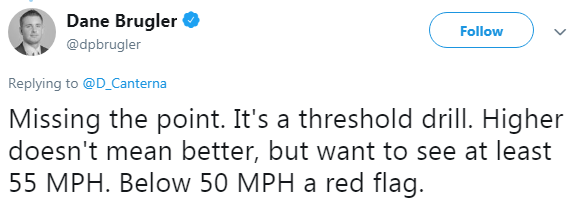
Reading further into the combine, a football velocity of 55 MPH is looked at as a threshold. While this number doesn’t necessarily mean a better player, it does serve as a red flag if someone is below that mark. 

C:\Users\Tucker Stobbe\Documents\Dane Brugler - 55 MPH Threshold.PNG
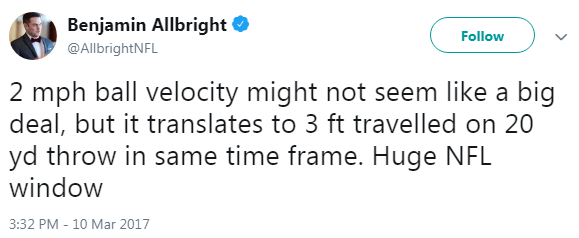
C:\Users\Tucker Stobbe\Documents\Benjamin Albright - Velocity Importance.PNG
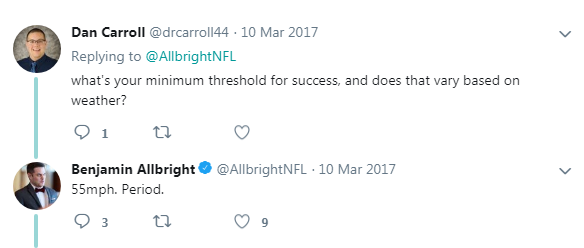
C:\Users\Tucker Stobbe\Documents\Benjamin Albright - 55 MPH Threshold.PNG

This is similar to baseball scouting and player analysis, pitch velocity can’t be deemed everything but assists provides great assistance as an indication of future success.   

So, if we hypothetically say that the 55 MPH number is a threshold and follow Bialak’s approach to convert it into baseball velocity, we have the average of 92.4 MPH for a baseball thrown.  That number is unique because the average major league fastball is 92.8, quite close to the threshold in football velocity described above.

Baseball front offices could then put this insight to work by seeking out quarterbacks from the combine in the past who may not be on an NFL roster, CFL roster, or playing football in general. Target players who have a 55 MPH or higher velocity on their football. Dig deeper and look at player biography pages from their college playing days, which often reveal whether the QB played baseball in high school, as well which would be a plus. 

Baseball teams are currently developing velocity programs or have them in place to help their pitchers gain strength and work towards maximizing their velocity.  By taking an already developed skill set for throwing, as well as an elite athlete, like near-NFL level quarterback baseball executives may uncover a new pipeline for pitchers who could play professional baseball for their organizations. 

Quarterback List of Velocity over 55 MPH (Not in the NFL, CFL, AAF or affiliated football)

Kevin O’Connell (2008), Paul Smith (2008), Rhett Bomar (2009), Curtis Painter (2009), Josh Freeman (2009), Drew Willy (2009), John Wilson (2009), Scott Tolzien (2010), Patrick Devlin (2011), Colin Kaepernick (2011), Jordan Jefferson (2012), Chandler Harnish (2012), Austin Davis (2012), Tyler Wilson (2013), Bradley Sorensen (2013), James Vandenberg (2013), Zac Dysert (2013), Tyler Bray (2013), Jordan Lynch (2014), Keith Wenning (2014), Jeff Mathews (2014), Stephen Morris (2014) Anthony Boone (2015), Joel Stave (2016), Nic Shimonek (2018)